

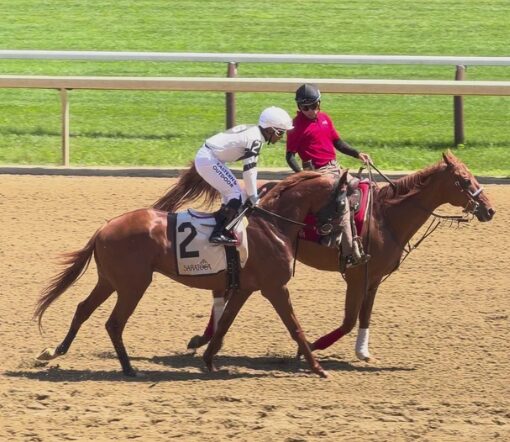
The best racing colors are two strongly contrasting shades, used in large simple shapes, with sleeves and a cap that look different from the body. That is the core of good jockey silks design. A horse in your colors should be easy to find from the top of the grandstand, on a TV screen, and in a winner’s circle photo. Some owners spend weeks on a design that looks great on a hanger, then watch it fade into the pack at the top of the stretch. The sections below explain how to avoid that, and how a custom silks maker can turn your idea into something that works on the track.
Which Patterns Work Best for Jockey Silks?
At race speed the eye notices three things: the overall color, the big shapes, and whether the sleeves match the body. Anything smaller than about four inches across tends to vanish.
Bold, simple patterns win. A solid body is the easiest to spot, and in a field full of busy designs it can be the one that stands out most. Halves and quarters are clear and easy to tell apart. Wide hoops work well if you keep to four or five bands at most. A sash, which is a diagonal band across the chest, is hard to miss. One or two large chevrons look sharp, while six small ones turn into noise. Large diamonds, stars, or blocks also work if there are only a few and they are spaced apart.
Fine pinstripes, tiny dots, gradients, and detailed crests or monograms on the body tend to fail. Cameras blur thin stripes into one muddy tone, and gradients turn to mush on screen. If you have a logo or initials you care about, put them on the cap or a sleeve cuff, where they have a better chance of being seen in photos.
Here is a simple test. Shrink your design to thumbnail size on your phone, then hold the phone at arm’s length. If you can still name the pattern, it will probably read on the track.
How Much Do Sleeves and the Cap Matter?
More than most owners expect. In a crowded field, the body of the silks is often hidden by the horse beside you. The sleeves stay visible because a jockey’s arms are always moving. Contrasting solid sleeves, hooped sleeves, or a bold chevron on the arm can identify your horse even when the body is blocked. Two stables with similar body colors can be told apart instantly by their sleeves.
The cap has a different role. It fills the frame in head-on photos and photo finishes, and it is what owners and trainers watch in the paddock. A cap that contrasts with both the body and the helmet cover is worth the extra thought.
How Do Cameras and Weather Change Racing Colors?
A computer screen hides several things that matter on track. Saturated colors photograph better than soft ones, because cameras tend to flatten subtle shades. A rich royal blue stays royal blue on TV, while a muted slate blue can look gray.
Rain is another test. Wet fabric looks darker by a shade or two, which can wipe out a design that only just works when dry. If your color pairing barely separates on a sunny day, it will struggle on a sloppy track.
It also helps to look at who else races at your home track. Check the colors your trainer’s other owners use, and the stables you see most often. Two similar designs in the same race are a real annoyance, and ten minutes of looking can prevent it.
Does the Fabric Affect the Way Your Colors Look?
Yes. Despite the name, modern silks are not made of silk. They are made from synthetic performance fabrics, usually polyester or a polyester and spandex blend. Polyester holds dye well through washing and sunlight, and it dries quickly. The stretch from spandex allows a closer cut that does not billow at speed or restrict the rider’s shoulders.
Saratoga Silks Co. makes its silks from breathable poly-spandex with an aerodynamic cut. The company’s website promises accurate and vibrant colors, along with a durable build. It also says it has received no complaints about fraying or pilling. That matters because a design is only as good as the fabric carrying it. Colors that fade after a few washes lose the contrast you worked so hard to create.
Do You Need Approval Before Ordering?
Racing colors are registered, and two owners cannot hold the same combination. Rules differ from place to place. The Jockey Club handles registration in the United States, and individual states and racing commissions add their own requirements. The company’s process page notes that if you will be racing in New York State, your design has to be approved by the Jockey Club first.
The practical lesson is to sketch two or three designs you would be happy with and check availability before you place an order. It is much easier than learning that your favorite was claimed decades ago.
What Is the Process for Ordering Custom Silks?
The process at Saratoga Silks Co. has four stages. You send in your design. The team then matches fabrics to your color scheme and suggests options, and swatches can be mailed if you want to see the shades in person. Once everything is approved, the silks are made in the company’s shop in Saratoga Springs. Then you wait for the best part, watching your colors on the track.
Some practical details are useful to know. The site lists more than 1,000 color shades, plus custom color strike-offs for something specific. Color swatches cost $9. The company says standard turnaround is a few days, and rush production is possible within 24 hours after you approve your proof. Pricing depends on the design, but the FAQ says a set typically runs from $320 to $380, with shipping averaging $9 unless you ask for expedited delivery. Designs, colors, and logos are saved, so reorders usually go faster. The company can also ship straight to a track or trainer, and it makes custom blinkers to match your silks.
One important point is that payment cannot be refunded once it is received, and changes to an approved design carry an extra fee. That makes it worth being sure of your design before you approve the proof. You can see the full range of options at Saratoga Silks Co..
Final Thoughts on Jockey Silks Design and Racing Colors
Good racing colors are built on contrast, big shapes, and sleeves with their own identity. Judge every idea from far away, in the rain, and on a small screen before you commit. Keep to two or three colors, avoid fine detail on the body, and check that your design is available to register. Then choose a maker who understands fabric, fit, and speed, because a well-made set keeps your colors sharp all season.
FAQ
What colors are best for jockey silks?
The best racing colors are pairs that differ clearly in lightness. Yellow or white on navy, green, or maroon works well. Black or royal blue on white or pale yellow also holds up. Orange or gold against brown, purple, or deep green is another strong choice. Avoid two dark shades together, because they blur into one shape from far away.
How many colors should I use in my jockey silks design?
Three colors are plenty, and four is the ceiling. Once you go past that, the design turns into noise instead of an easy-to-read pattern. Two strong colors with a clear contrast between them often work better than a busy mix.
Are jockey silks really made of silk?
No. The name is a holdover from the days when racing colors were made of real silk. Modern silks are made from synthetic performance fabrics, usually polyester or a polyester and spandex blend. These fabrics are light, breathable, quick to dry, and good at holding color. Saratoga Silks Co. uses breathable poly-spandex with an aerodynamic cut.
Which patterns are easiest to see on the track?
Big, simple shapes are the easiest to spot. Solid bodies, halves, quarters, wide hoops, sashes, and one or two large chevrons all read well at speed. Thin pinstripes, tiny dots, gradients, and detailed logos on the body usually fail. A good test is to shrink your design to thumbnail size and hold it at arm’s length. If you can still name the pattern, it should work.